
Department Visibility and Access List controls which employees can view a department's Objectives and Key Results in Profit.co. Department OKR pages also flag items awaiting approval directly in the toolbar, so approvers don't need a separate page to find them.
Table of Contents
- What is the Department Visibility and Access List Feature?
- Why Does Department Visibility and Access List Matter?
- How Do I Manage Department Visibility and Pending Approvals?
- What Happens When You Use Department Visibility and Access List?
- What Are the Best Practices for Department Visibility and Access List?
- Related Articles
- What Are Some Frequently Asked Questions About Department Visibility and Access List?
What is the Department Visibility and Access List Feature?
Department Visibility and Access List controls who can see and access a department's Objectives and Key Results in Profit.co. You choose from five visibility levels, Public, My Management, My Directs, My Team, and Access List, so each objective reaches only the audience it's meant for. The same five levels also apply to individual and team OKRs, not just department-level ones.
This control governs who can view an OKR, not who gets alerted about pending approvals. Department OKR pages separately surface a pending-approval count for items awaiting review, which is covered under How It Works below.
The Five Visibility Levels
| Visibility Level | Who Can View | Best Used For |
|---|---|---|
| Public | Everyone in the company | Company-wide initiatives, transparent goals, and cross-functional objectives |
| My Management | Your manager and all managers above them | Goals requiring leadership oversight and approval |
| My Directs | Only the people you manage directly | Tactical team objectives for immediate reports |
| My Team | All employees reporting to you directly or indirectly | Department-wide goals across your entire team hierarchy |
| Access List | Only selected individuals, teams, or departments | Sensitive projects, confidential initiatives, or selective cross-functional collaboration |
Why Does Department Visibility and Access List Matter?
Department visibility and access lists let you match each OKR's audience to its sensitivity, instead of exposing every objective to the entire company by default. The pending-approval badge adds a second layer of value: it surfaces review work exactly where managers already look.
- Streamlined communication: Objectives and Key Results reach only the audience that needs them, without cluttering everyone else's OKR list.
- Reduced error risk: Restricting sensitive department objectives to authorized users keeps confidential details from reaching people who shouldn't see them.
- Stronger collaboration: Team-based visibility levels let the people who share a Key Result see it without needing individual access grants.
- Better security posture: Visibility controls limit who can view strategic objectives to those with a legitimate need.
- Flexible transparency: You choose how open or confidential a department's OKRs are, objective by objective.
- Hierarchical alignment: Managers and leadership above them can see the goals they're accountable for through My Management and My Team.
- Approval work surfaces where managers already work: The pending-item badge appears directly on the Department OKRs page, so approvers don't need to check a separate page to know items are waiting.
- Hierarchy stays visible during review: Pending Key Results display their parent Objective, giving reviewers context without leaving the page.
- No disruption to the existing approval flow: Approve and reject actions still happen on the OKR review screen; the panel only helps you find what needs review.
How Do I Manage Department Visibility and Pending Approvals?
Department Visibility and Access List and the pending-approval indicator are two separate capabilities on the same Department OKRs page. Configure the first, then use the second to track review work.
Method 1: Set Department Visibility and Access List
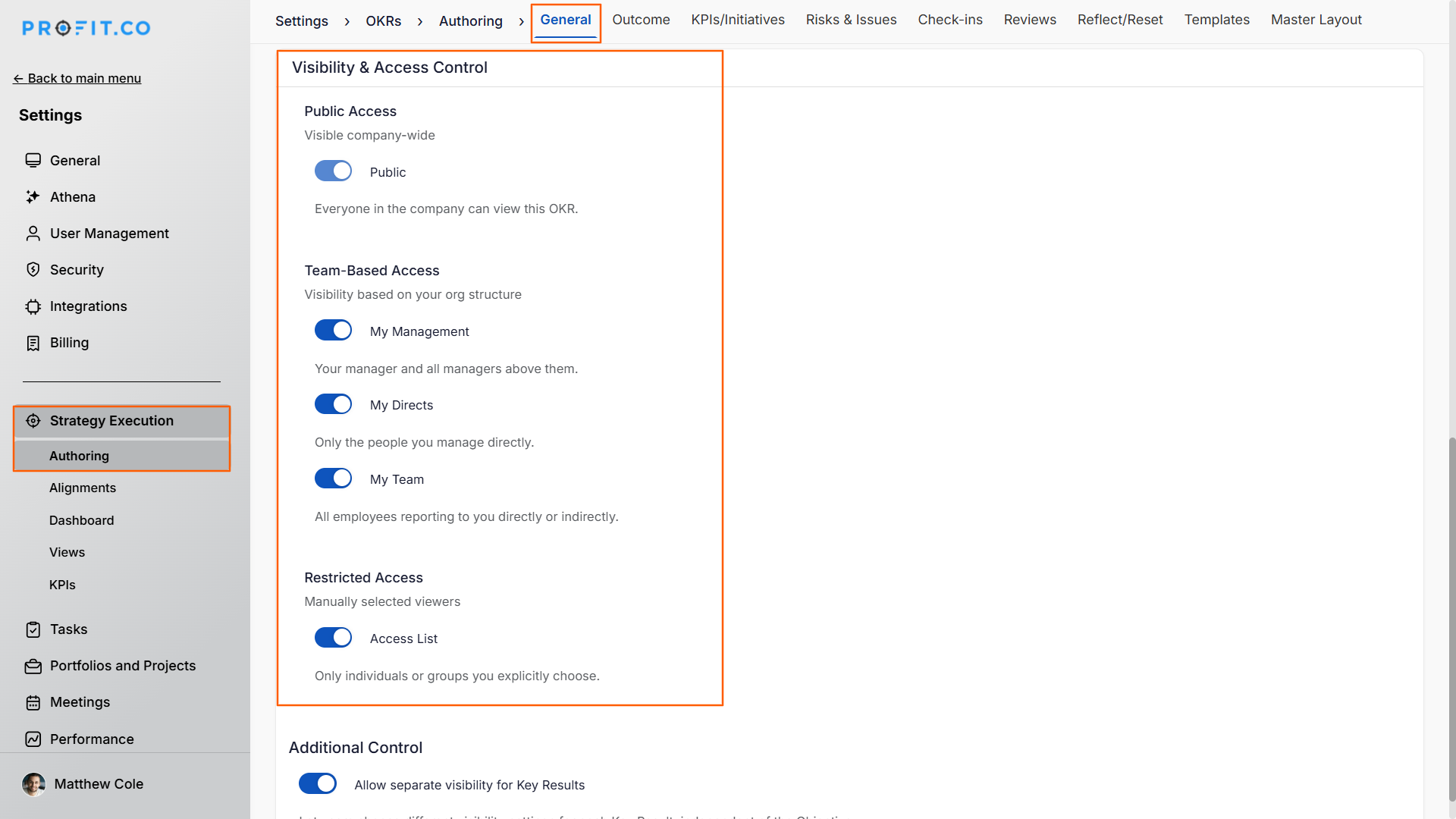
Step 1: Enable Visibility Levels in Settings
- Go to Settings in your Profit.co account.
- Navigate to Strategy Execution and click Authoring.
- On the General tab, under Visibility and Access Control, turn on the visibility levels your organization needs.
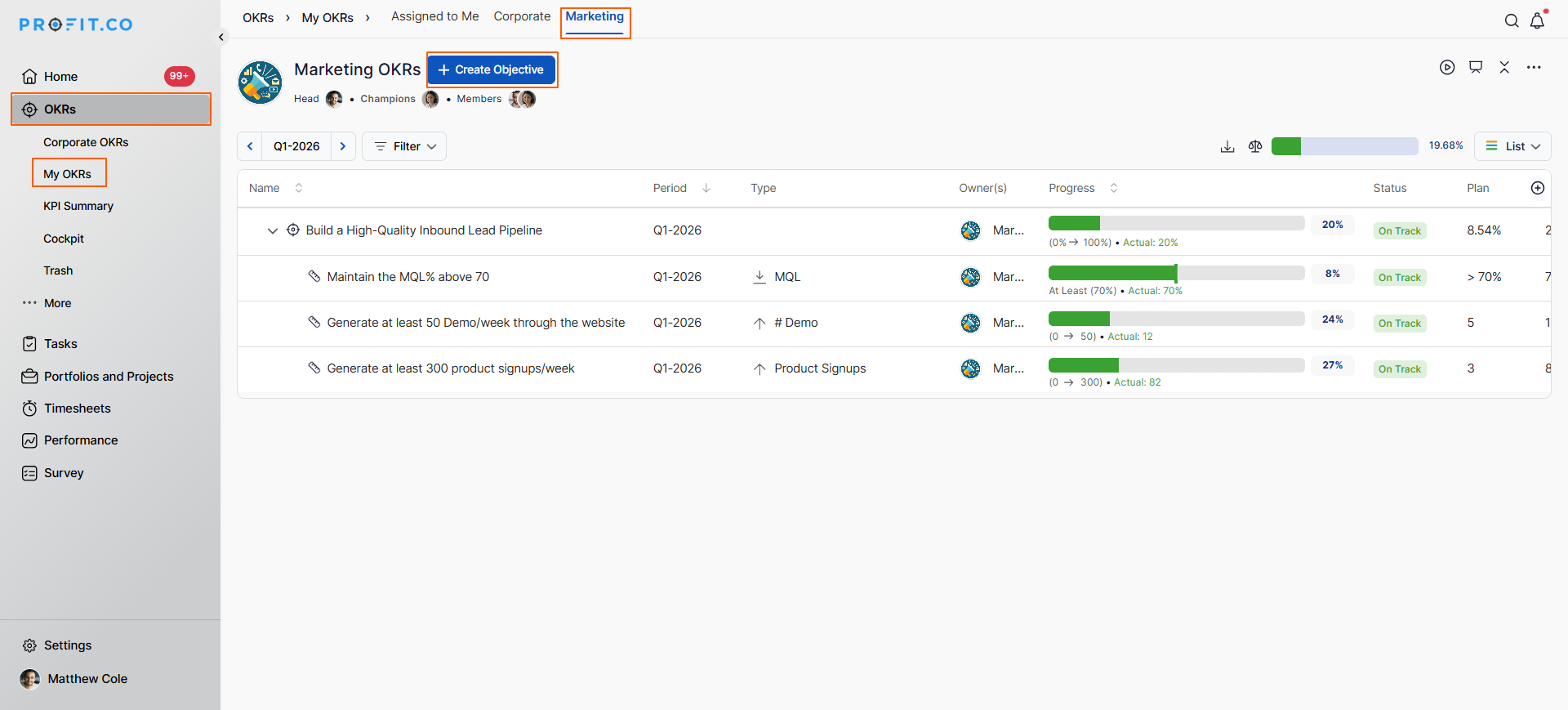
Step 2: Open the Department OKR Tab
- Go to OKRs and click on the My OKRs menu from the left navigation panel.
- Switch to the Department OKR tab, for example Marketing or Corporate.
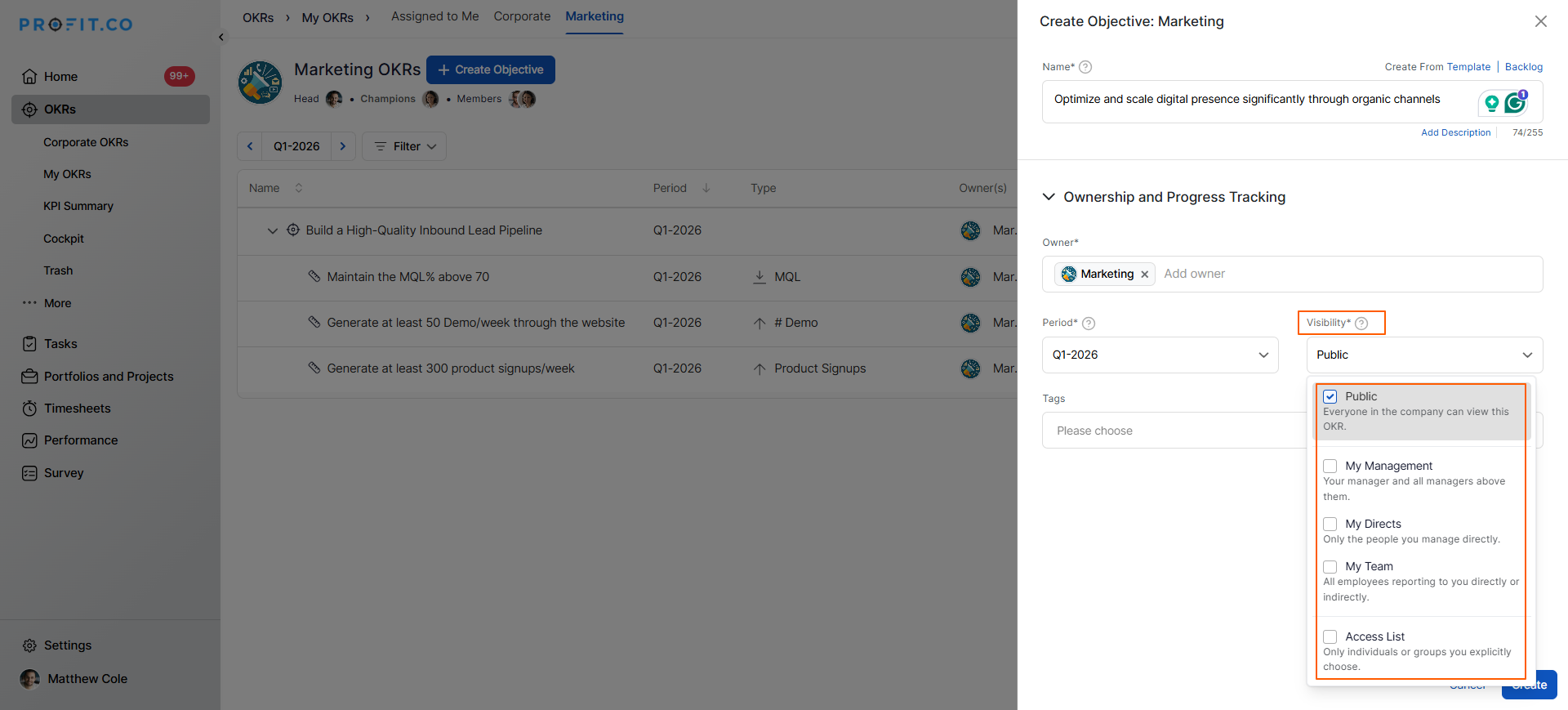
Step 3: Set Visibility on the Objective
- Click on the Create Objective button.
- Open the Visibility dropdown in the side panel and select a level.
- Click Create or Save to apply the setting.
Method 2: View Pending Approvals on a Department OKR Page
Step 1: Open the Department OKRs Page
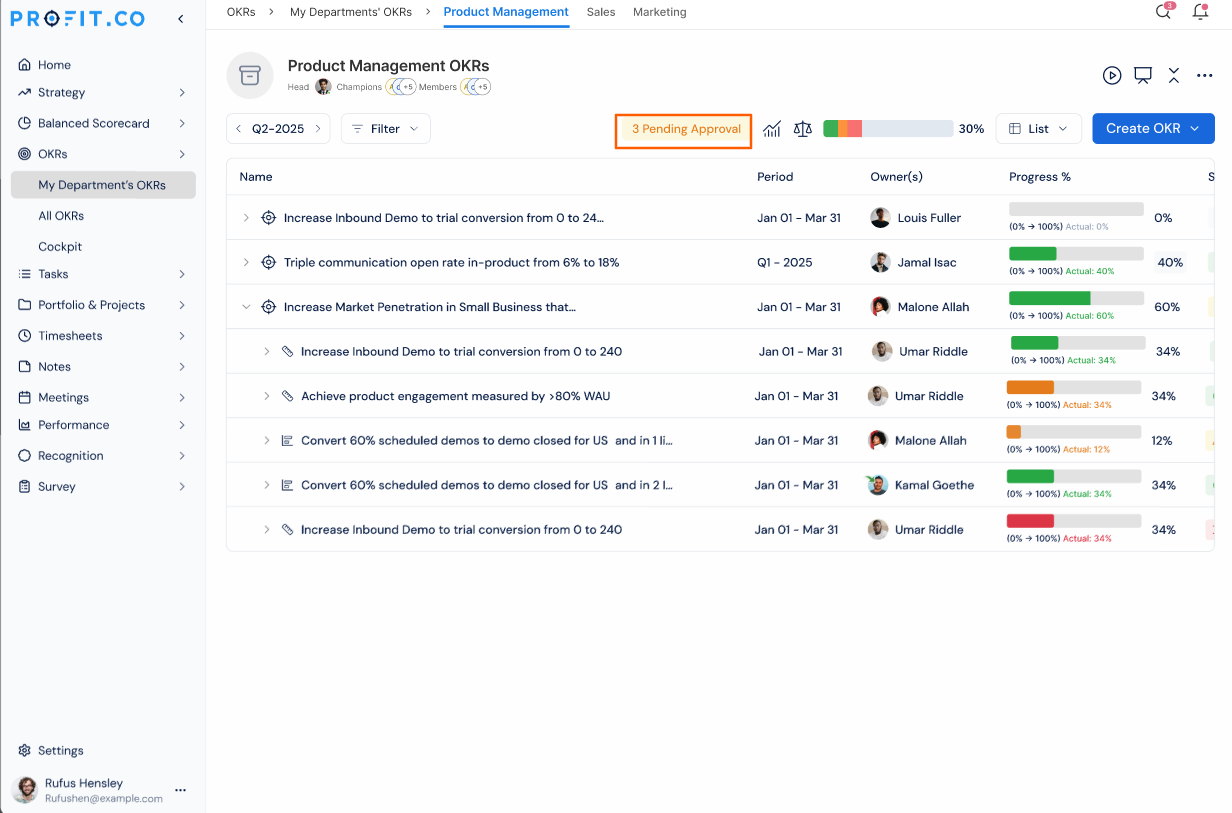
- Navigate to any Department OKRs page, for example Product Management OKRs.
- Select the badge in the toolbar showing the pending-item count.
- Review each entry's Name, Period, Owner(s), Progress, Approvers, and Submitted columns.
- Approve or reject the item from that screen.
Note
Pending Objectives display their child Key Results beneath them for context, and a standalone pending Key Result shows a breadcrumb naming its parent Objective.
What Happens When You Use Department Visibility and Access List?
| Scenario | What Happens |
|---|---|
| You disable a visibility level in Settings > Strategy Execution > Authoring > General. | Profit.co removes that level from the Visibility dropdown when you create an Objective afterward. |
| You create an Objective without selecting a Visibility level. | Profit.co applies Public visibility by default, making the objective viewable to everyone in the company. |
| You change the visibility level on an existing department OKR. | Profit.co applies the new visibility level to the objective, and only users who match that level can view it going forward. |
| You submit an Objective or Key Result for approval. | Profit.co adds it to the pending count shown in that department's OKRs page toolbar. |
| You clear every pending Objective and Key Result in a department. | Profit.co removes the pending badge from that department's OKRs page. |
| You open the pending-approval panel and select an entry. | Profit.co opens the existing OKR review screen for that entry, since the panel itself has no approve or reject controls. |
What Are the Best Practices for Department Visibility and Access List?
- Match visibility to sensitivity: Use Public for general initiatives, My Management for goals requiring oversight, and Access List for confidential projects.
- Set a default based on culture: If transparency is valued, default to Public visibility; if confidentiality matters more, lean on the hierarchical levels or Access List.
- Communicate visibility choices: Let team members know why certain OKRs have restricted visibility to avoid confusion or mistrust.
- Enable levels before you need them: Turn on every visibility level your organization plans to use in Settings before creating Objectives, since disabled levels won't appear as choices later.
- Check the breadcrumb before approving in isolation: On a standalone pending Key Result, confirm the parent Objective named in its breadcrumb before you approve or reject it from the review screen.
Related Articles
- How to Restrict Visibility for Key Results in Profit.co?
- How do I enable Approval flow to Create or edit OKRs?
What Are Some Frequently Asked Questions About Department Visibility and Access List?
Yes. Individual, team, and department OKRs all use the same five visibility levels in Profit.co.
It's specific to the department you're viewing. The badge and panel reflect only that department's pending Objectives and Key Results.
No. The breadcrumb only appears when a pending Key Result's parent Objective isn't itself pending; otherwise the Key Result is listed as a context row beneath its pending parent.
Execute your strategy with confidence
Connect OKRs, tasks, and teams in one place with Profit.co
